In this guide 8 sections
ETIM classification sorts technical products into classes, and each class describes its products with a fixed set of features, values and units, all carrying language-independent identifiers. When two editions of a manufacturer’s catalogue disagree on ETIM data, first establish the ETIM version of each edition, then compare class and feature identifiers, and only then compare values and units.
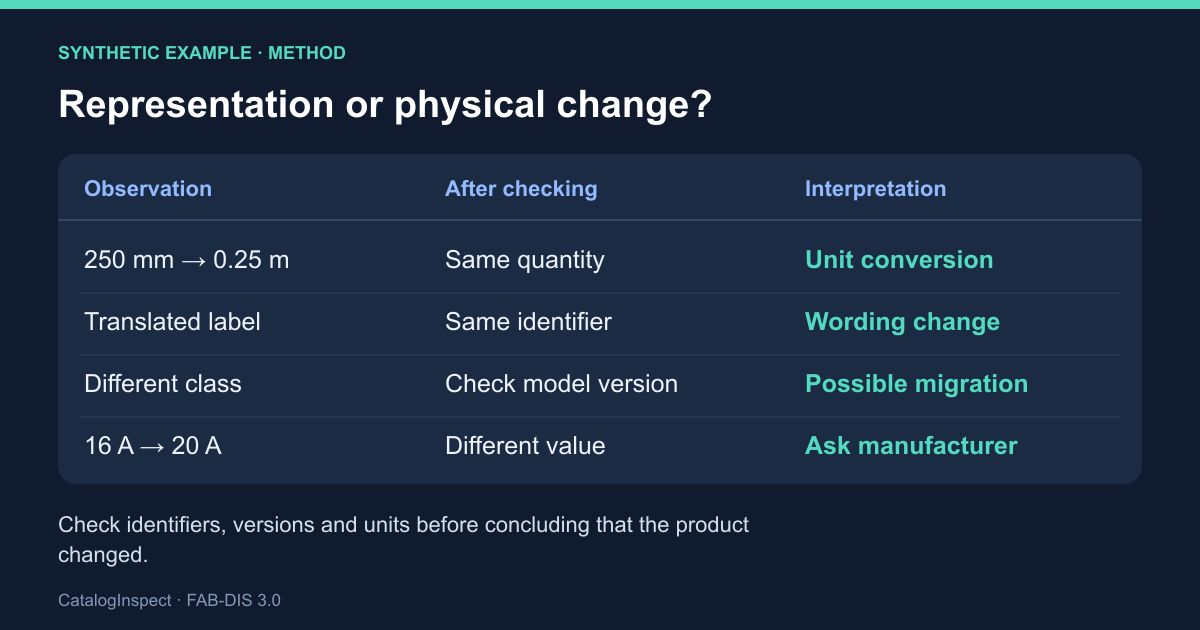
A changed ETIM feature therefore does not necessarily mean the product changed: a version migration, a translated label or a unit conversion can alter the representation of an unchanged physical item. The method below is for data teams reviewing two FAB-DIS 3.0 editions from one manufacturer (FAB-DIS is the French product data exchange format used between manufacturers and distributors). It supports technical review; a class mapping alone does not prove that two products can be substituted for one another.
What is ETIM classification?
ETIM is an international classification standard for technical products, governed by ETIM International, with local ETIM organisations in many countries. Its official classification overview presents one model available in 17 languages, used by manufacturers, wholesalers and end users to describe products in the same structured way.
According to ETIM’s model information, the model has two levels. Every product class belongs to one product group; the group mainly helps manage classes, while the class carries the description. Each class lists features, and each feature has a type:
| Feature type | What it holds | What to check between two editions |
|---|---|---|
| A (alphanumeric) | One value from a fixed list of permitted values | Same value code in the same class and version |
| L (logical) | Yes or no | A blank where the other edition says yes or no |
| N (numeric) | One number with a unit | Same quantity after unit conversion |
| R (range) | Two numbers, a lower and an upper limit, with a unit | Both bounds and the unit |
Classes, features, values and units each have a unique identifier that does not depend on language, while their descriptions do. Classes can also have synonyms, which help people find them but carry no identifier. For a catalogue review, the practical consequence is simple: compare identifiers, and treat labels as supporting evidence.
In a FAB-DIS 3.0 file, ETIM data sits in the conditional C04 ETIM block. FAB-DIS states on its conditional blocks page that it supports ETIM versions 7.0 to 10.0 and that an inconsistency between class, attribute, value and version blocks the product’s integration at the distributor. The FAB-DIS 3.0 questions page explains how the ETIM block fits into the file. If the GTIN of the same item also differs between editions, review the changed GTIN and product identity first, before you attribute any technical value to an assumed unchanged trade item.
How ETIM versions and releases work
ETIM’s release policy describes official releases about every three years. ETIM 10.0 is the current official release; ETIM International announced its publication in December 2024, the result of 5,264 requests for change, with 119 new classes and new feature groups that sort features into sections such as material, electrical or dimensions.
Between official releases, a dynamic release contains the full official release plus new and changed classes marked with change codes. It can still contain elements tagged for deletion in the next official release. Two editions exported a few months apart can therefore differ in ETIM content even when both claim the same major version.
Record for each edition:
- the ETIM version declared, or the one confirmed by the manufacturer if nothing is declared;
- for a dynamic release, the export date and any change code on the classes concerned;
- whether the C04 block is present in both editions, and for which product codes.
Do not assume that the FAB-DIS version establishes the ETIM version: they describe different models. ETIM International points to difference reports, reserved for its members, and to its online classification management tool for the full list of changes between releases. Without that change information, keep a class change open rather than guessing a mapping.
How to compare ETIM data between two catalogue editions
- Align the product codes. Pair each item in the previous edition with the same manufacturer product code in the new one. Items that are added or missing are a scope question, not an ETIM question.
- Compare the ETIM version. If it differs, route every class or feature difference through the migration checks below before reading values.
- Compare the class identifier. Same identifier with a different label: a wording or translation change. Different identifier: a reclassification to explain.
- Compare feature identifiers within the class. Note features that appear, disappear or change type.
- Compare values. For A features, compare the value code in its class and version context; a matching label is not enough. For N and R features, convert to the same unit before comparing.
- Record a decision per difference, with its evidence: explained by migration, confirmed technical change, or open question for the manufacturer.
You can look up a class code and browse its details in the ETIM Viewer, then compare its feature definitions with the version used in each edition.
Classify the kind of difference
An internal review table can distinguish label changes, model changes, value changes and newly missing information. These are workflow categories, not official ETIM classification rules.
| Synthetic observation | Previous value | New value | First check |
|---|---|---|---|
| Class wording | French label A | English label A | Same class identifier? |
| Numeric feature | 250 mm | 0.25 m | Same quantity after conversion? |
| Class identifier | Previous class code | New class code | Documented version mapping? |
| Technical value | 16 A | 20 A | Confirmed correction or product change? |
| Logical feature | Yes | Blank | Information withdrawn or simply not supplied? |
The class codes are deliberately described rather than invented. Real mappings must use the actual identifiers and versions in the source files.
Preserve original labels even when you normalise them for presentation. They help explain whether an apparent difference came from language, spelling or a changed technical meaning; the multilingual product description checklist covers the label side of that review.
ETIM class vs feature: what changes in a version migration
A class change and a feature change call for different checks. A class change alters which feature list applies to the product; a feature change alters one property within a class that stays the same. In a migration, an old class may split into several destinations, and features may be added, removed, regrouped or change type. Treating every migration as a simple one-to-one rename can lose meaning.
Keep unmapped elements visible in a separate queue. Assigning the closest-looking class to maximise completion may make downstream filters less reliable. An unresolved classification matters most when it drives navigation or selection in your product database or webshop.
Record whether each proposed mapping is official, manufacturer-confirmed or still under investigation. That status belongs alongside the mapping, not in an informal note elsewhere.
A synthetic mapping dossier can keep two different states. For “version A / feature X → version B / feature Y”, a documented confirmation of the same property and unit permits value comparison in this fictitious case. For “version A / X → version B / Z”, similar labels alone leave the relationship unconfirmed and the values not comparable. X, Y and Z are teaching symbols, not actual ETIM codes.
In a real record, retain both received identifiers, exact model versions, mapping source, reviewer and scope. An official or manufacturer-confirmed relationship must stay distinguishable from a mapping still under investigation. Filling every mapping cell is not evidence of semantic correctness.
Unit changes and physical values
For confirmed identities, compare the same quantity in compatible units. 250 mm and 0.25 m are equal after conversion; the guide to converting catalogue dimensions in mm, cm and m sets out the conversion and rounding checks. 16 A and 20 A are different values, but the file difference alone cannot tell you whether the product changed or an old error was corrected.
For R features, compare both bounds: a range that widens at one end is a different statement from a range that shifts. Missing values deserve a separate state: an empty feature does not establish that the physical property ceased to exist.
Do not impose a general tolerance across unrelated technical features. Any rounding or acceptance rule must be justified for the particular quantity and application.
Validate downstream consequences
Ask the product owner whether the difference affects dimensioning, compatibility, customer filters or published technical documentation. A classification correction may require reindexing your own catalogue without requiring a new physical item record.
Deliver old and new versions, compared identifiers, raw values, any normalised values and the decision. Separate explained migrations, confirmed technical changes and open questions. The sample difference report between two editions shows how changed fields are laid out per product code; ETIM interpretation still depends on version context and manufacturer evidence.
Frequently asked questions
What is ETIM classification used for?
ETIM classification groups technical products into classes and describes each class with standard features, values and units. Manufacturers, wholesalers and end users rely on it to exchange product data that software can read and filter in the same way.
What is the difference between an ETIM class and an ETIM feature?
A class is the product category, such as a type of cable or switch, and it determines which features apply. A feature is one technical property within that class, with a type that says whether it holds a listed value, a yes or no, a number or a range.
Which ETIM versions does FAB-DIS 3.0 support?
FAB-DIS states that it supports ETIM versions 7.0 to 10.0 in the C04 ETIM block. An inconsistency between class, attribute, value and version blocks the product’s integration at the distributor.
How often is a new ETIM version released?
ETIM International publishes an official release about every three years, and ETIM 10.0 was published in December 2024. Dynamic releases between official versions add new and changed classes marked with change codes.
Does a changed ETIM class mean the product changed?
No, not on its own. A new ETIM version, a reclassification or a corrected class can change the code of an unchanged item, so check the version and the mapping before asking the manufacturer about the product itself.
Official sources & scope
This guide describes a working method. The examples are fictional; the official documentation remains the reference for the format rules. CatalogInspect is an independent service.