Compare two Excel sheets for price differences: old vs new
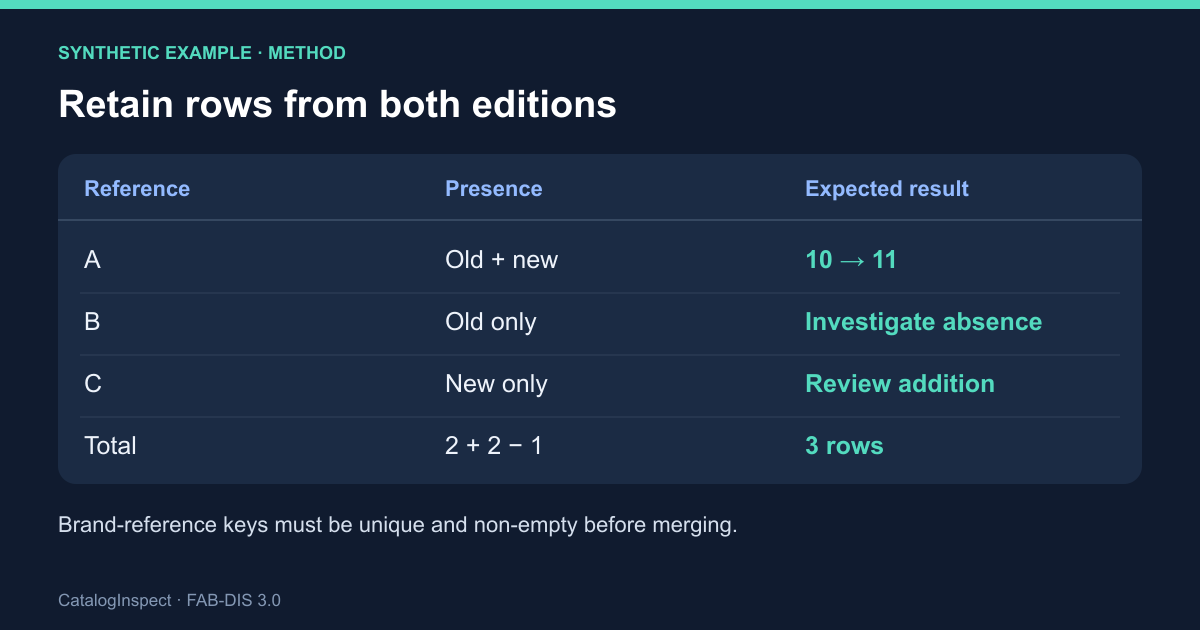
Compare old and new supplier price lists in Excel by product code: keep rows from both sheets, flag added and missing items and get each change in € and %.
Practical methods to spot changes, understand differences and prepare for your next supplier update.
Explore the guidesCompare old and new supplier price lists in Excel by product code: keep rows from both sheets, flag added and missing items and get each change in € and %.
Stop catalogue fields starting with =, +, - or @ running as formulas. Keep the raw CSV for imports, give reviewers typed text cells, test a reopened copy.
Does a blank cell keep, overwrite or clear an ERP value? Separate blank cells, omitted columns and clear instructions, then test each field before import.
Tare is gross weight minus net weight at the same packaging level. Worked case and pallet example, GS1 definitions and checks before you compare editions.
Split a foreign-currency price change into the supplier’s own increase and the exchange rate effect: compare at a constant rate, then at dated rates.
Calculate an EAN-13 check digit from twelve digits with the 1-3 weighting, verify a received GTIN-13 and handle leading zeros, wrong digits and blanks.
Import reading old prices or blanks? Check the result each XLSX formula cell stores, recalculate a working copy, then test it with your real importer.
Dates four years and a day out? Check the workbook’s 1904 date system, confirm the raw serial, then add or subtract 1,462 once, on a working copy.
Prices like 12,50 stored as text? Convert them with the source file’s locale, keep the raw value, and test zero, blank and 1,234 before comparing prices.
Import CSV into Excel without losing data: confirm UTF-8, declare the delimiter and quote rules, load codes as text, then check field and record counts.
Record a SHA-256 file hash for each supplier catalogue edition you receive, verify archived copies, then link rules and decisions to rebuild any report.
Check a technical datasheet revision when the URL stays the same: compare the revision, file hash, language and variants covered, then record what applies.
Convert supplier catalogue dimensions to millimetres before you compare editions: conversion factors, a worked example, GS1 rounding and unit checks.
Review multilingual product descriptions across two catalogue editions: find missing languages, outdated translations and changed units before publishing.
ETIM classification explained: classes, features, values and units, and how to compare ETIM versions in two catalogue editions without false alerts.
Follow a product supersession chain link by link: check direction, kit quantities, cycles and effective dates before you map old product codes to new ones.
Calculate an order that meets a supplier’s minimum order quantity and order multiple: formula, worked example, rounding rules and the cost of extra stock.
Accept an ERP supplier catalogue import on evidence: freeze the batch, reconcile counts, read back prices and units, and test rollback before go-live.
Build an approval matrix for supplier catalogue changes: one owner per change, the evidence it needs and what stays on hold, then release what is closed.
Successive trade discounts multiply, not add: 20% then 10% is 28% off. Work out the net price, the single equivalent discount and the margin effect.
Find which supplier price applies on a given date: set an end-date convention, detect overlaps and gaps between price list editions, then record the rule.
Compare old and new supplier price lists in Excel by product code: keep rows from both sheets, flag added and missing items and get each change in € and %.
Zero prices, blank cells and unreadable amounts need separate states in a supplier price list. Learn when a % change is undefined and what to report.
A smaller supplier file does not prove products were dropped. Check if it is full, partial or changes only, then compare the ranges both editions cover.
Changed GTIN for the same product code? Find the packaging level, check the GS1 change rules, then protect stock, labels and open orders before updating.
Keep leading zeros in product codes by reading them as text, then build a matching key one rule at a time and check collisions before joining two files.
Calculate a supplier price increase: (new − old) ÷ old × 100, then weight it by your purchase volumes. Worked example, spend coverage and review steps.