In this guide 8 sections
A product supersession chain is the ordered list of product codes that replaced one another, such as A → B → C, with the current code at the end. Review it link by link: confirm the direction, quantity and effective date of each replacement, and do not treat the last code as an equivalent of the first until the manufacturer’s evidence says so.
This method applies to two FAB-DIS 3.0 editions of one manufacturer’s catalogue. It does not establish equivalents between different suppliers, and it does not approve a substitution for every application.
What is a product supersession chain?
A supersession means the manufacturer has replaced one product code with another, usually because the old item is discontinued or about to be. When the replacement is itself replaced later, the links form a chain: A is superseded by B, B by C, and C is the code to order today.
In a FAB-DIS 3.0 file, the FAB-DIS guide to conditional blocks places substitutions in block C06 SUBSTITUTION. The substituted product code must appear in the discontinued block (C05 ARRET), and the code that replaces it in the commercial block (B01 COMMERCE); without that consistency, the transition cannot take place. The October 2026 FAB-DIS release adds a different relationship, CORTYP = ALTERNATIVE in block C02 CORRESPONDANCE, for a code suggested in case of temporary unavailability while both codes remain active and on sale.
A chain is directional. In a one-way supersession, C covers A’s applications, but A cannot replace C where the newer design is required. A two-way relationship, where either code fits any listed application, needs its own evidence.
A changed barcode on an unchanged product code is a separate question: see how to review a changed GTIN in a manufacturer catalogue.
How do you review a supersession chain in a new catalogue edition?
- List every pair. Extract each old code → new code relationship from the new edition, with its block, type, dates and any quantity or condition stated by the manufacturer.
- Check both ends. The old code should be listed as discontinued and the new code should be on sale in the same edition. A target missing from the file is not necessarily an error: the file may be a partial extract rather than a full catalogue. It remains unconfirmed until you have its identity, data and availability.
- Join the pairs into chains. Follow each link forward until you reach a code with no successor. Keep every intermediate step: if B introduced an installation restriction or an availability date, a shortcut from A to C hides it.
- Classify each link. Supersession, alternative, required accessory or kit (see the table below).
- Convert quantities. Express each replacement per unit of the old code, then check pricing units, pack sizes and minimum order quantities and order multiples, which can add excess stock to a nominal replacement.
- Date and approve. Record from which date each link applies and who confirmed it for which application.
Supersession, alternative or kit: which link is it?
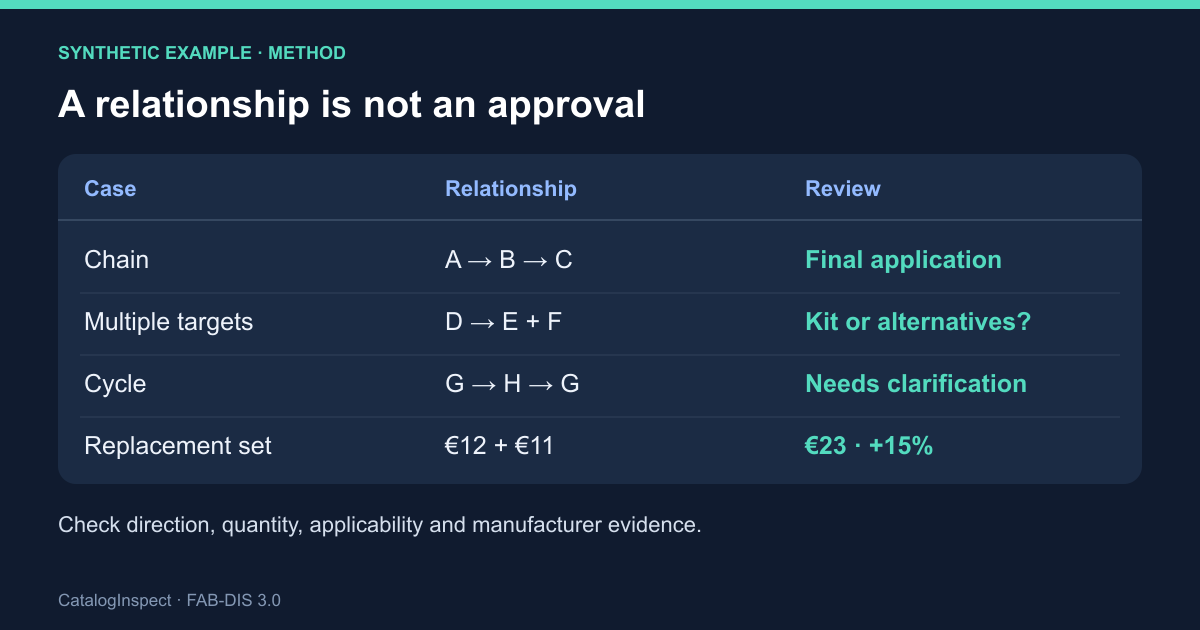
Two product codes connected by an arrow can call for very different purchasing actions. Keep the relationships apart before you simplify anything.
| Synthetic relationship | Structure | Question to settle |
|---|---|---|
| A → B, B → C | Chain | Does C satisfy A’s original application? |
| D → E and F | Multiple targets | Buy both (kit) or choose one (variants)? |
| G → H, H → G | Cycle | Contradictory data or missing context? |
| J → K, K absent from the file | Undocumented target | Out-of-scope item or error? |
| L ↔ M, both on sale | Alternative | Temporary option or lasting replacement? |
The conditional-blocks guide also states that a product code which cannot be bought without another one is flagged in block C01 EXTENSION with the NONSEUL attribute. Look for that signal before you read a multi-target link as a choice.
A technical property that changes twice along a chain may matter even when the first and last descriptions look similar. Check the supporting product documents rather than relying on the arrow alone.
How do you calculate the cost of a replacement kit?
Calculate the cost of everything needed to replace one unit of the old code, not the price of the first successor. In a fictitious example, A costs €20, E costs €12 and F costs €11:
| Fictitious scenario | Calculation | Cost per A | Change vs A |
|---|---|---|---|
| E alone (misread) | 12 | €12 | −40% |
| Kit 1 E + 1 F | 12 + 11 | €23 | +15% |
| Kit 2 E + 1 F | 2 × 12 + 11 | €35 | +75% |
Comparing only A with E shows a misleading 40% reduction. If the confirmed kit is 2 E + 1 F, a requirement for three A needs six E and three F before order rounding. None of these figures establishes a general equivalence; they only show why the quantity rule must be confirmed first.
How do you detect cycles and broken chains?
While following one branch, stop when the next code already appears among the codes on the current path: G → H → G returns to G and forms a cycle. Keep the links involved and ask the manufacturer for clarification; do not pick an arbitrary end point.
Convergence is not a cycle. A → B → D and A → C → D both reach D, but D is not an ancestor on either path. If two required branches of the same kit each call for D, add their quantities in a common unit. Keep alternative branches as separate scenarios, and check which relationships apply on the intended order date.
A broken chain is one where a link points to a code that has no data in the edition you received. Record it as unconfirmed rather than deleting it, so the gap stays visible in the next review.
Who approves the replacement and from which date?
Product specialists assess fit and restrictions, purchasing checks cost, availability and agreements, and logistics reviews quantities, remaining stock and order picking. The catalogue approval matrix for purchasing, data and logistics shows how to split those decisions.
Each approval should state the application and the date it covers. Open orders need separate handling: changing a master-data relationship does not change what a customer agreed to buy or what the manufacturer committed to supply. Decide explicitly whether existing stock of the old code is sold through before the successor takes over.
What should the final replacement mapping contain?
For each old code, keep the source chain, chosen target, required quantities per old unit, effective date, manufacturer evidence, owner and excluded cases. Separate confirmed relationships from proposed mappings still under review.
The CatalogInspect difference report features set out how added, missing and changed product codes are presented between two editions. A replacement decision stays defensible when the full path and its conditions remain available, rather than being reduced to a single unexplained pair of codes.
Frequently asked questions
What is the difference between a superseded product and an alternative product?
A superseded product is replaced by its successor, usually because it is discontinued or about to be. An alternative is another product code suggested alongside it, for example during temporary unavailability, while both remain on sale.
What does one-way and two-way supersession mean?
In a one-way supersession, the new code covers the old code’s applications, but the old code cannot be used where the newer design is required. In a two-way relationship, either code fits every listed application, which needs explicit evidence from the manufacturer.
How do you find the latest product code in a supersession chain?
Follow each link forward until you reach a code with no successor, and stop if a code reappears on the same path, because that is a cycle. Keep every intermediate step, since a restriction or date introduced midway still applies to the end of the chain.
Can one product be replaced by two product codes?
Yes. The two targets may form a kit that you must buy together or be variants you choose between, so confirm which before you compare prices or set up a mapping.
Can you still sell stock of a superseded product?
Often, for the applications it already fits, but the manufacturer’s information and your own agreements decide. Record the date from which the successor applies and how remaining stock of the old code is handled.
Official sources & scope
- FAB-DIS — Blocs conditionnels (new tab)Accessed on
- FAB-DIS — October 2026 release (new tab)Accessed on
This guide describes a working method. The examples are fictional; the official documentation remains the reference for the format rules. CatalogInspect is an independent service.