In this guide 7 sections
A minimum order quantity (MOQ) is the smallest quantity a supplier accepts for one product on one order; an order multiple is the step in which quantities may increase above it. To calculate an order, take the larger of your requirement and the MOQ, then round it up to the next permitted multiple: with a requirement of 25, a minimum of 24 and a multiple of 12, you order 36.
A supplier can therefore leave unit prices unchanged and still make your next order more expensive. This guide shows the formula, a worked example, the alternative rule where steps start at the minimum, and how to value the extra stock. All figures are fictitious.
What is a minimum order quantity (MOQ)?
The MOQ sets a floor, the order multiple sets the steps, and the pack size describes how the goods are physically packed. Those numbers sometimes match, but they answer different questions, so record each one separately.
| Term | Question it answers | Synthetic example |
|---|---|---|
| Minimum order quantity (MOQ) | What is the smallest quantity accepted? | 24 units |
| Order multiple | In which steps can the quantity grow? | 12 units |
| Pack size (case) | How many units are in one case? | 12 units per case |
| Minimum order value | What is the smallest order value accepted? | €150 excl. VAT |
Agree the order unit first. A minimum of 2 means something very different if it counts cases of 12 or single units. Convert the requirement, the minimum and the multiple into the same unit before any calculation.
MOQ vs order multiple
An MOQ alone allows any quantity at or above it: with a minimum of 24, ordering 25 is fine. An order multiple alone allows only steps: with a multiple of 12, you can order 12, 24 or 36, but not 25. Most supplier terms combine both, and that combination is what produces surplus units.
Minimum order value in units
When the minimum is a value, divide it by the unit price and round up: €150 at €4 per unit is 37.5, so 38 units. If the product also has a multiple of 12, the order becomes 48 units. A minimum order value often applies to the whole order rather than one product, so check which level the supplier means.
How to calculate an order with a minimum and a multiple
The most common rule accepts multiples counted from zero, with a floor at the minimum. For a positive requirement B, a minimum M and a multiple m:
Order quantity = m × ceiling(max(B, M) / m)
Ceiling means the smallest whole number greater than or equal to the value. An exact multiple stays unchanged. The multiple must be strictly positive and the minimum confirmed and non-negative; treat blank, negative or unreadable values as exceptions to resolve, never as a default of 1.
- Convert
B,Mandminto the same order unit. - Take the larger of the requirement and the minimum.
- Divide by the multiple and round up to a whole number.
- Multiply back by the multiple.
- Subtract the requirement to see the surplus.
| Synthetic example | Old rule | New rule |
|---|---|---|
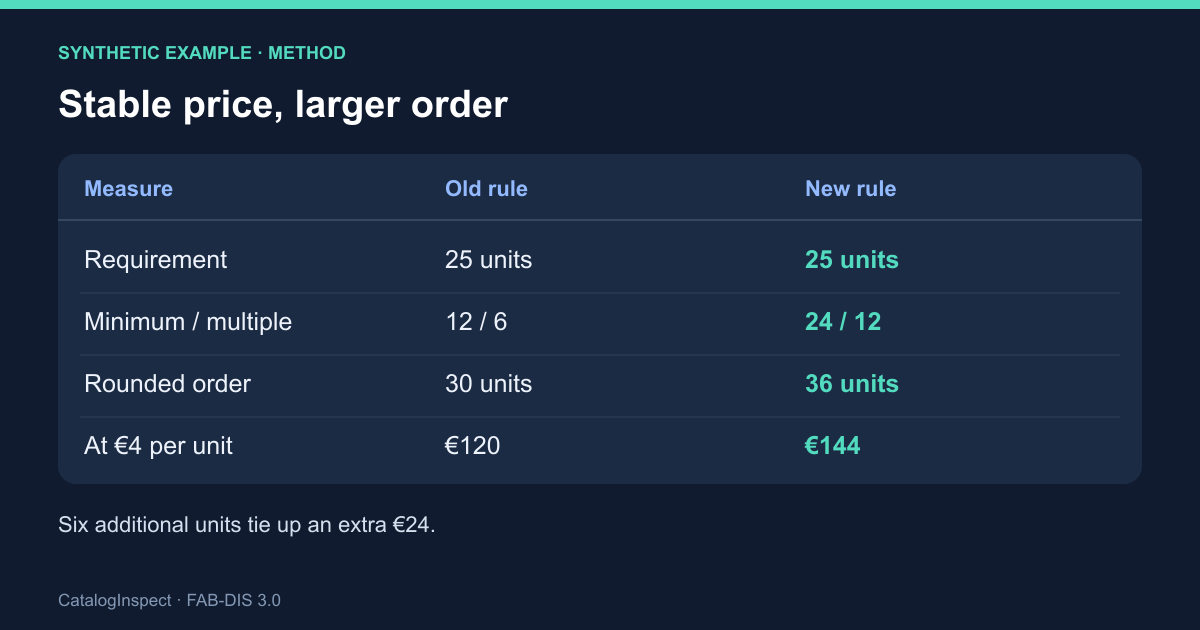
| Requirement | 25 units | 25 units |
| Minimum | 12 units | 24 units |
| Multiple from zero | 6 units | 12 units |
| Orderable quantity | 30 units | 36 units |
| Surplus over requirement | 5 units | 11 units |
At an unchanged €4 excl. VAT per unit, the order value rises from €120 to €144. The new rule adds six units and €24 to the order value at the same unit price. That is a quantity effect, not a price effect: a weighted supplier price increase analysis holds quantities constant to measure price changes, so report the two effects separately.
Zero demand should normally produce no order in this model rather than trigger the supplier minimum. Proactive replenishment is a separate decision.
When the minimum is not a multiple
Some suppliers accept a minimum followed by fixed increments. With a minimum of 10 and increments of 6, valid quantities are 10, 16, 22, 28 and so on. A requirement of 25 then gives 28 units, whereas multiples of 6 from zero with a minimum of 10 would give 30.
For increments of m from a minimum M:
Order quantity = M + m × ceiling(max(0, B − M) / m)
At M = 10, m = 6 and B = 25, this gives 10 + 6 × 3 = 28. A requirement of 22 stays at 22; a requirement of 23 jumps to 28. Ask the supplier which model applies: the difference only appears when the minimum is not itself a multiple, which is exactly when errors go unnoticed.
Decimal steps and lengths
For goods sold by length or weight, calculate in a unit that keeps the permitted step a whole number. With a confirmed step of 2.5 m and no higher minimum, work in centimetres: 500 cm stays at 500 cm, while a requirement of 510 cm becomes 750 cm. The same discipline applies to dimension and unit conversions in supplier catalogues.
Where order quantities appear in a FAB-DIS 3.0 file
The FAB-DIS guide to mandatory blocks places commercial data in block B01 COMMERCE, including the base unit UB and the minimum sale quantity QMV, while block B02 LOGISTIQUE carries logistics data such as the dimensions and weight of packed or unpacked items. Read the notice for your edition to know how a field is defined, then confirm with the agreed supplier terms how it applies to your orders: a quantity below the minimum may be refused, accepted with a surcharge or priced differently.
When two editions from the same manufacturer differ, compare these fields for every product code, not only the price column. A sample difference report between two catalogue editions shows the kind of side-by-side view that makes a changed minimum or pack size visible next to an unchanged price.
The cost of extra stock
Surplus units have a purchase value, but that value is not automatically a cost. It is cash tied up until the units are sold or used. A carrying-cost estimate needs assumptions about storage time, cost of capital, handling, space and the risk of obsolescence.
In the example, the new rule leaves 11 surplus units instead of 5. The six extra units tie up €24. With an assumed annual carrying rate of 24% and two months before they are used, the carrying cost is about €24 × 24% × 2 / 12 = €0.96. Show additional quantity, additional purchase value and estimated carrying cost in separate columns, and state the assumptions.
The same surplus means different things for different products. A fast-moving item absorbs it in the next cycle; a specialist spare part may stay on the shelf for months, and its carrying cost and obsolescence risk become the real issue.
What to check when a supplier changes its MOQ
- List the products whose minimum, multiple or pack size changed between the old and new edition; comparing the old and new price list on product code gives you that list.
- Recalculate typical orders with your own demand data, starting with frequently ordered products bought in small quantities.
- Ask logistics to confirm the unit and packaging interpretation, and purchasing to confirm which rounding model the supplier applies.
- Decide per product: accept the surplus, consolidate orders, negotiate an exception or change replenishment settings.
- Record the effective date of the new terms alongside the approved quantity settings, and test the rule in your ERP before it governs live orders.
Frequently asked questions
What does MOQ mean?
MOQ stands for minimum order quantity, the smallest quantity of a product a supplier accepts on one order. It can be expressed in units, in cases or as a minimum order value.
What is the difference between a minimum order quantity and an order multiple?
The minimum order quantity is a floor, while the order multiple is the step in which the quantity can increase. With a minimum of 24 and a multiple of 12, you can order 24, 36 or 48 units, but not 25.
How do you round an order up to a multiple?
Divide the quantity by the multiple, round the result up to the next whole number and multiply it back by the multiple. For 25 units and a multiple of 12, that gives 3 × 12 = 36 units.
Can you order less than the minimum order quantity?
It depends on the agreed supplier terms. A smaller order may be refused, accepted with a surcharge or priced differently, so confirm the rule with the supplier before changing your order settings.
How do you convert a minimum order value into units?
Divide the minimum order value by the unit price and round up to a whole unit. A €150 minimum at €4 per unit gives 38 units, or 48 if the product is sold in multiples of 12.
Official sources & scope
- FAB-DIS — Blocs obligatoires (new tab)Accessed on
This guide describes a working method. The examples are fictional; the official documentation remains the reference for the format rules. CatalogInspect is an independent service.