In this guide 7 sections
To calculate a net price with successive trade discounts, multiply the list price by (1 − each discount) in turn: €100 less 20% and then 10% gives €72, a 28% single equivalent discount, not 30%. Then compare that net cost with the same selling price to see what a list-price change really does to your gross margin and markup.
The second discount applies to the price already reduced by the first, which is why successive discounts never add up. The same rule explains why a supplier’s list-price increase does not tell you the full effect on gross profit: you need the applicable net cost under the actual discount agreement, compared with a consistently defined selling price.
How to calculate a net price with successive trade discounts
For a list price before discounts P, followed by discounts r1, r2 and so on:
Net = P × (1 − r1) × (1 − r2) × …
Work through it in four steps:
- Convert each discount into a net factor: 20% becomes
0.80, 10% becomes0.90, 5% becomes0.95. - Multiply the factors together without rounding:
0.80 × 0.90 = 0.72. - Multiply the list price by that combined factor:
100 × 0.72 = €72. - Round only the final unit price, to the precision your agreement or system uses.
The following amounts are synthetic and exclude VAT.
| Successive discounts | Combined net factor | Net price on €100 | Single equivalent discount |
|---|---|---|---|
| 20% | 0.80 | €80.00 | 20% |
| 20% then 10% | 0.80 × 0.90 = 0.72 | €72.00 | 28% |
| 20% then 12% | 0.80 × 0.88 = 0.704 | €70.40 | 29.6% |
| 20% then 10% then 5% | 0.72 × 0.95 = 0.684 | €68.40 | 31.6% |
Single equivalent discount
The single equivalent discount is 1 − (1 − r1) × (1 − r2) × …. For two discounts there is a shortcut: r1 + r2 − r1 × r2, so 20% and 10% give 0.20 + 0.10 − 0.02 = 28%. Use it to compare two offers: “30% then 2%” (31.4%) is a better deal than “20% then 12%” (29.6%), although both add up to 32% on paper.
Does the order of discounts matter?
Not when every discount is a percentage: multiplication gives the same net price in any order. It does matter as soon as a fixed amount is involved. On €100, 10% followed by €5 off gives €85.00, while €5 off followed by 10% gives €85.50. Follow the sequence written in the agreement.
Where successive discounts sit in FAB-DIS price data
A FAB-DIS file (the French product data exchange format used between manufacturers and distributors) carries catalogue data such as list prices. FAB-DIS describes negotiated discounted terms in a separate CNR file, so that a change in negotiated conditions does not require a new catalogue file.
The FAB-DIS guide to negotiated discounts separates T01 (discounts by product family) from T02 (discounts by item) and states that they are not cumulative with each other. Each one can express a single discount or a cascade of discounts. Net prices by item and quantity sit in their own tab (T03): if you already have an agreed net price, use that amount without reapplying discounts it includes.
Before calculating, record currency, pricing unit, dates and discount scope. A family discount may exclude particular products, and an item-specific net price may override a general formula. Do not stack benefits unless the agreement allows it. Set aside list prices that are blank, zero or unreadable as zero, missing or invalid supplier prices rather than applying discounts to them. Freight, deferred rebates, non-recoverable taxes and other costs are left out of this example so the calculation stays explicit.
Two FAB-DIS 3.0 editions from the same manufacturer show how list prices moved; the negotiated terms and their effective dates provide the extra evidence needed to model purchasing cost. To measure the overall effect across many products, weight each net movement by your purchase volumes, as explained in the supplier price increase analysis.
Net price after a list-price increase
Keep the discounts unchanged and apply them to the new list price:
| Synthetic example | Calculation | Net cost |
|---|---|---|
| Previous list price €100 | 100 × 0.80 × 0.90 | €72.00 |
| New list price €105, same discounts | 105 × 0.80 × 0.90 | €75.60 |
| Difference | 75.60 − 72.00 | +€3.60 |
List price and net cost both rise by 5% here only because the discount factors remain unchanged. If the agreement changes, calculate the new net amount rather than carrying the list-price percentage across automatically.
A separate synthetic agreement-change scenario gives a different answer. Keep the new list price at €105, but apply 20% followed by 12%: 105 × 0.80 × 0.88 = €73.92. Net cost then rises by 1.92 / 72 = 2.67%, despite a 5% list-price rise. This is an alternative scenario, not the €75.60 amount used in the main example. Confirm both the new terms and the date on which each price applies before selecting a scenario.
Which second discount keeps the previous net price?
Divide the previous net cost by the new list price to get the combined factor you need: 72 / 105 = 0.6857, a single equivalent discount of 31.43%. With the first discount kept at 20%, the second must be 1 − 0.6857 / 0.80 = 14.29%. Check: 105 × 0.80 × 0.8571 = €72.00. That figure gives purchasing a precise target for a negotiation, not a promise that the supplier will accept it.
Gross margin and markup at a fixed selling price
Use the confirmed net purchase cost C and selling price V, both per unit and excluding VAT. Unit gross profit is M = V − C. Gross margin is M / V when V > 0. Markup is M / C when C > 0. Calculate the percentage change in net cost only when the previous cost is positive.
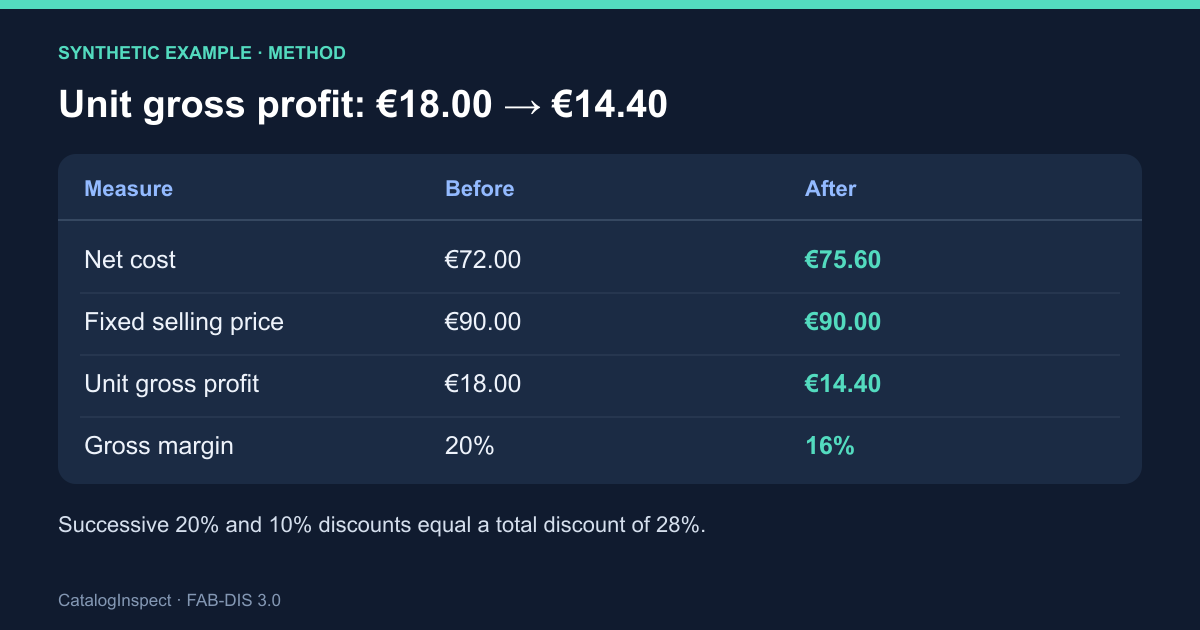
| Selling price held at €90 | Before | After |
|---|---|---|
Net cost C | €72.00 | €75.60 |
Unit gross profit M | €18.00 | €14.40 |
Gross margin M / V | 20% | 16% |
Markup M / C | 25% | 19.05% |
The €3.60 cost increase removes 20% of the previous unit gross profit. Gross margin falls by four percentage points, from 20% to 16%; markup falls from 25% to 19.05%. Margin and markup describe the same profit against different denominators, so a 20% margin and a 25% markup are the same price. Use the same labels and denominators in the calculation and in the handoff to purchasing and sales.
Selling price needed to keep your margin
For a positive net cost C and a target gross margin t from 0% to below 100%, the theoretical selling price is C / (1 − t). A 20% target with a €75.60 net cost gives 75.60 / (1 − 0.20) = €94.50 excluding VAT. Keeping the 25% markup gives the same result: 75.60 × 1.25 = €94.50.
Preserving the previous euro gross profit instead gives another answer: 75.60 + 18 = €93.60. The rate target protects the percentage; the euro target protects the contribution per unit.
These are calculation scenarios, not automatic pricing recommendations. Demand, contracts, other costs and the business’s commercial policy still matter. Show both options when the decision maker needs to choose between a rate target and an absolute contribution target, and do not label one as the required price without explaining the objective.
Checks before you share the result
Present list-price movement, net-cost movement, unit gross-profit loss and selling-price scenarios separately. Then run these checks:
- Test values: with a €100 list price, two confirmed 0% discounts give €100, 20% followed by 0% gives €80, and 20% followed by 10% gives €72.
- Missing terms: an absent discount value does not automatically mean that no discount applies. Keep missing or uninterpretable prices distinct from an explicit zero, and leave the net cost pending until the agreement is known.
- Units: apply discounts to a list price expressed in the same pricing unit and pack size in both editions; otherwise the comparison mixes different quantities.
- Undefined ratios: a €0 selling price leaves the gross margin rate undefined, and a €0 net cost leaves markup undefined.
- Scope: list products with unresolved units, missing terms or unclear agreement dates rather than estimating them silently.
The catalogue difference report shows which list prices, pack sizes and units changed between two manufacturer catalogue editions; your own margin analysis keeps the agreement evidence and selling assumptions. That record supports a practical choice between negotiation, repricing and accepting a temporary reduction in gross profit.
Frequently asked questions
Is a 20% and 10% discount the same as 30%?
No. The second discount applies to the price already reduced by the first, so 20% then 10% leaves 0.80 × 0.90 = 72% of the list price. The single equivalent discount is 28%, not 30%.
How do you calculate the single equivalent discount?
Multiply the net factors of each discount and subtract the result from 1. For two discounts you can also use r1 + r2 − r1 × r2, which gives 28% for 20% and 10%.
Does the order of successive discounts change the net price?
Not when all discounts are percentages, because multiplication gives the same result in any order. It does change the net price when a fixed amount discount is combined with a percentage.
What is the difference between gross margin and markup?
Gross margin divides unit gross profit by the selling price, while markup divides it by the net cost. With a €72 cost and a €90 selling price, the €18 profit is a 20% margin and a 25% markup.
What selling price keeps the same gross margin after a cost increase?
Divide the new net cost by one minus the target margin. A €75.60 net cost with a 20% target margin needs a selling price of €94.50 excluding VAT.
Official sources & scope
This guide describes a working method. The examples are fictional; the official documentation remains the reference for the format rules. CatalogInspect is an independent service.