In this guide 8 sections
To prove which supplier catalogue edition produced a comparison report, calculate a SHA-256 file hash of each original at receipt and check it again before any reuse. Retain the received originals, their hashes, the processing rules and the linked decision record: with those four elements, another reviewer can rebuild the same result months later.
This method applies to two FAB-DIS 3.0 editions from the same manufacturer (FAB-DIS is the French product data exchange format used between manufacturers and distributors). It works with any archive location, and a file hash is never treated as proof of authorship or official conformity.
What to record when a catalogue edition arrives
A manufacturer may send two different files named catalogue.xlsx within a week. The filename identifies nothing on its own, so give each received file its own register entry:
| Register field | Synthetic example for edition E2 |
|---|---|
| Internal identifier | E2 |
| Received filename | catalogue.xlsx |
| Archived filename | DEMO-2027-01-E2-catalogue.xlsx |
| Sender and channel | DEMO manufacturer, confirmed supplier portal |
| Receipt date | 12 January 2027 |
| Algorithm and full digest | SHA-256, 64 hexadecimal characters |
| Dates declared in the file | the DATEDIT and DATEAPPLI values of the cartouche |
The FAB-DIS guide to the mandatory blocks describes the B00 CARTOUCHE block as the file’s identity card: it identifies the sender, the brands and the FAB-DIS version. Copy those declared values into the register next to the receipt data, and keep the two apart: what the file says about itself is not the same evidence as how and when you received it. For the structure of the blocks themselves, see what a FAB-DIS 3.0 file contains.
Keep the received file intact. Opening and saving it in a spreadsheet application can change its bytes or metadata. Work on a copy, and keep the link between that copy and the archived original so the copy never becomes the only remaining version. The same discipline applies later in the chain, when an edition passes the acceptance checks before an ERP catalogue import: the import batch should name the edition identifier and its digest.
How to calculate and check a SHA-256 file hash
A cryptographic hash is calculated from the bytes of the file. The NIST Secure Hash Standard states that digests are used to detect whether a message has changed since the digest was generated, and specifies SHA-256 with a 256-bit digest, written as 64 hexadecimal characters.
- Hash at receipt. Calculate the digest of the original before anyone opens it, and record the algorithm name with the full value, never a shortened one.
- Use any standard utility. A command-line SHA-256 utility gives the same digest for the same bytes, for example
sha256sum 'catalogue-source.xlsx'orshasum -a 256 'catalogue-source.xlsx'. With the second form, always state-a 256: without it, the default algorithm is not SHA-256. - Store the digest outside the file. Put it in the register or in a small text file next to the archive, not in the filename alone.
- Recheck before each reuse. Before you compare the old and new price list by product code, restore or forward an archived copy, compute its SHA-256 again, compare all 64 characters with the receipt record and note the check date.
- Quarantine a mismatch. If the digests differ, keep that copy out of the comparison and retrieve a verified copy from the archive or from the supplier.
Synthetic example: E2 was recorded at receipt with a digest ending in …c41e. The copy restored for an audit ends in …07b9. The copy is not the received file, whatever its name and size say, and it does not enter the comparison.
Do not confuse the hash with the filename, the file size or the download timestamp. Each helps to find an archive entry; none shows that the content is unchanged.
What a matching or different hash proves
Matching SHA-256 digests are strong practical evidence that two files contain identical bytes. Different digests establish a byte-level difference, but they do not say whether any useful product data changed.
| Observation | What it shows | What it does not show |
|---|---|---|
| Same digest, different filenames | The same bytes were received twice | That the second delivery was intended |
| Different digest, same filename | A different file | Which prices, codes or packs changed |
| Different digest, same reviewed cells | Bytes or internal metadata changed | A change in the catalogue content |
| Same digest as an approved edition | The approved bytes are being reused | Who authored the file or that it conforms to FAB-DIS |
A hash therefore answers “is this the file we received?”, not “what changed?” or “is this file valid?”. The content question needs a field-by-field comparison; the conformity question needs the appropriate official check, kept as separate evidence.
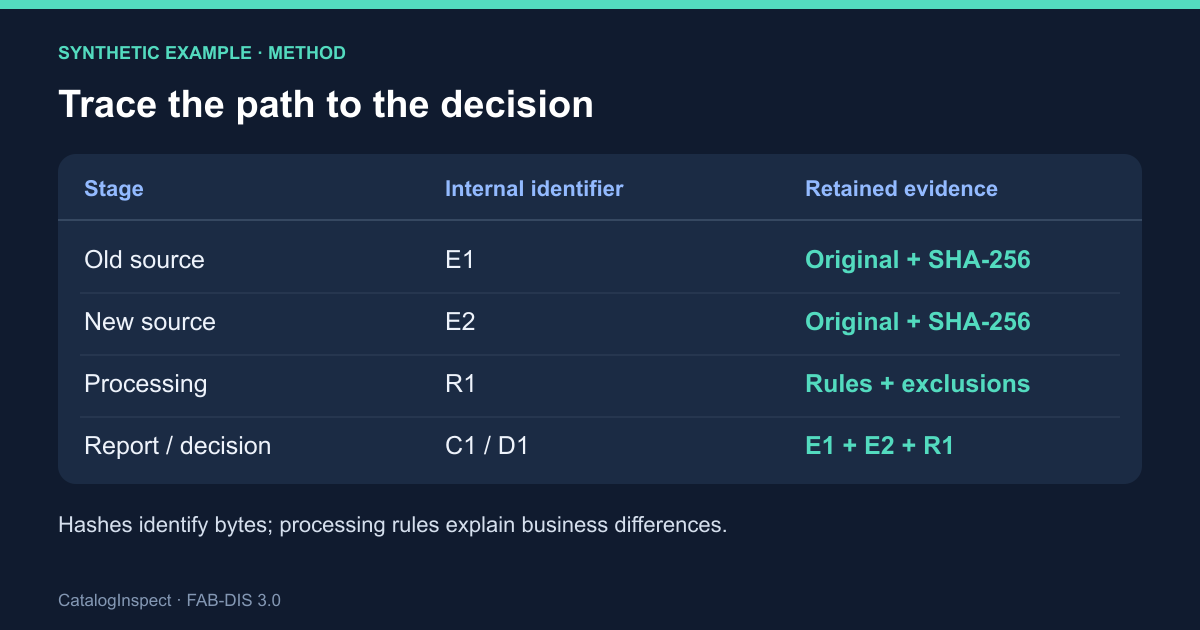
Link sources, rules and approval in one register
| Synthetic register element | Retained evidence |
|---|---|
| Source E1 | Original, received name, SHA-256 digest and receipt |
| Source E2 | Original, received name, SHA-256 digest and receipt |
| Processing R1 | Matching key, units, exclusions and rule version |
| Comparison C1 | E1 + E2 + R1, report and review date |
| Decision D1 | Accepted product codes, evidence and owner |
A report alone may not reveal whether spaces were removed, units converted or ambiguous codes excluded. The processing record explains how the source evidence became a set of differences. Version the rules that normalise product codes and keep leading zeros, including the evidence that authorises each transformation: a rule change can alter matches even when both source files are unchanged.
Each decision then needs a named owner. An approval matrix for supplier catalogue changes tells you who signs D1 and which evidence it must cite.
Rebuild a report from the archive
The test of a provenance record is simple: give the dossier to another reviewer and ask them to reproduce the identities and values, not merely the total.
Synthetic check, using the same old-only, new-only and matched states as a price list comparison:
- Verify the digests of E1 and E2 against the register.
- Apply R1: brand plus code as an exact text key, compatible price units and currency, confirmed number format, no excluded rows.
- E1 contains DEMO/A at €10 and DEMO/B at €20; E2 contains DEMO/A at €11 and DEMO/C at €30.
- Expected result:
2 + 2 − 1 = 3codes. A is matched with a change of +€1 (+10%), B is in the old edition only, C is in the new edition only. - Add a missing price on A in a test copy: A stays matched, its price comparison becomes unresolved. Record that exception rather than replacing the amount by zero.
If the rebuilt result differs, compare rule versions first, then digests. The cartouche offers one more quick control: the FAB-DIS guide states that the reference counts declared there must match the references listed in the COMMERCE and ARRET blocks.
When a corrected edition replaces a previous one
If corrected source E3 replaces E2, archive it as a new receipt linked to E2, with its own digest. Keep both files and link comparison C2 to E1, E3 and the rule version used.
Reopen the decisions whose evidence changed. Do not carry D1’s approval over to C2 because the filename looks familiar. The register makes the two situations distinguishable: an unchanged rule version with a new source digest, or a new rule version with unchanged source bytes.
What to archive, and how to keep it proportionate
The minimum useful record contains the identified sources with their digests, the rules and exclusions, the report and the decision. Keep enough detail to reproduce material transformations, without storing operational data nobody will read.
Store confidential catalogues, negotiated terms and decisions in an authorised location with access suited to your organisation, and set the retention period by your own policy. Internal source files and review logs should never become public examples. The sample difference report on the features page shows what a comparison result looks like before it joins that record.
Frequently asked questions
What is a SHA-256 file hash?
It is a 256-bit value, written as 64 hexadecimal characters, calculated from the bytes of a file with the algorithm defined in the NIST Secure Hash Standard. The same bytes always give the same digest, and any change to the bytes gives a different one with very high probability.
Does opening a spreadsheet change its hash?
Opening alone does not change the file, but saving it can rewrite bytes or internal metadata even when no cell was edited. Hash the original at receipt and work on a separate copy.
Does a different hash mean the product data changed?
No. It only shows that the bytes differ. A field-by-field comparison of the two editions shows whether prices, codes, pack sizes or other values actually changed.
Should I keep the original file or only its hash?
Keep both. The hash proves that a copy is identical to the received file, but only the original lets you rebuild a comparison or answer a supplier question later.
Does a matching hash prove that a FAB-DIS file is valid?
No. A hash says nothing about structure, authorship or conformity. Conformity is a separate check, and its result belongs in the register as its own piece of evidence.
Official sources & scope
- FAB-DIS — Le guide FAB-DIS (new tab)Accessed on
This guide describes a working method. The examples are fictional; the official documentation remains the reference for the format rules. CatalogInspect is an independent service.